Artificial intelligence has reached the classroom. What now?
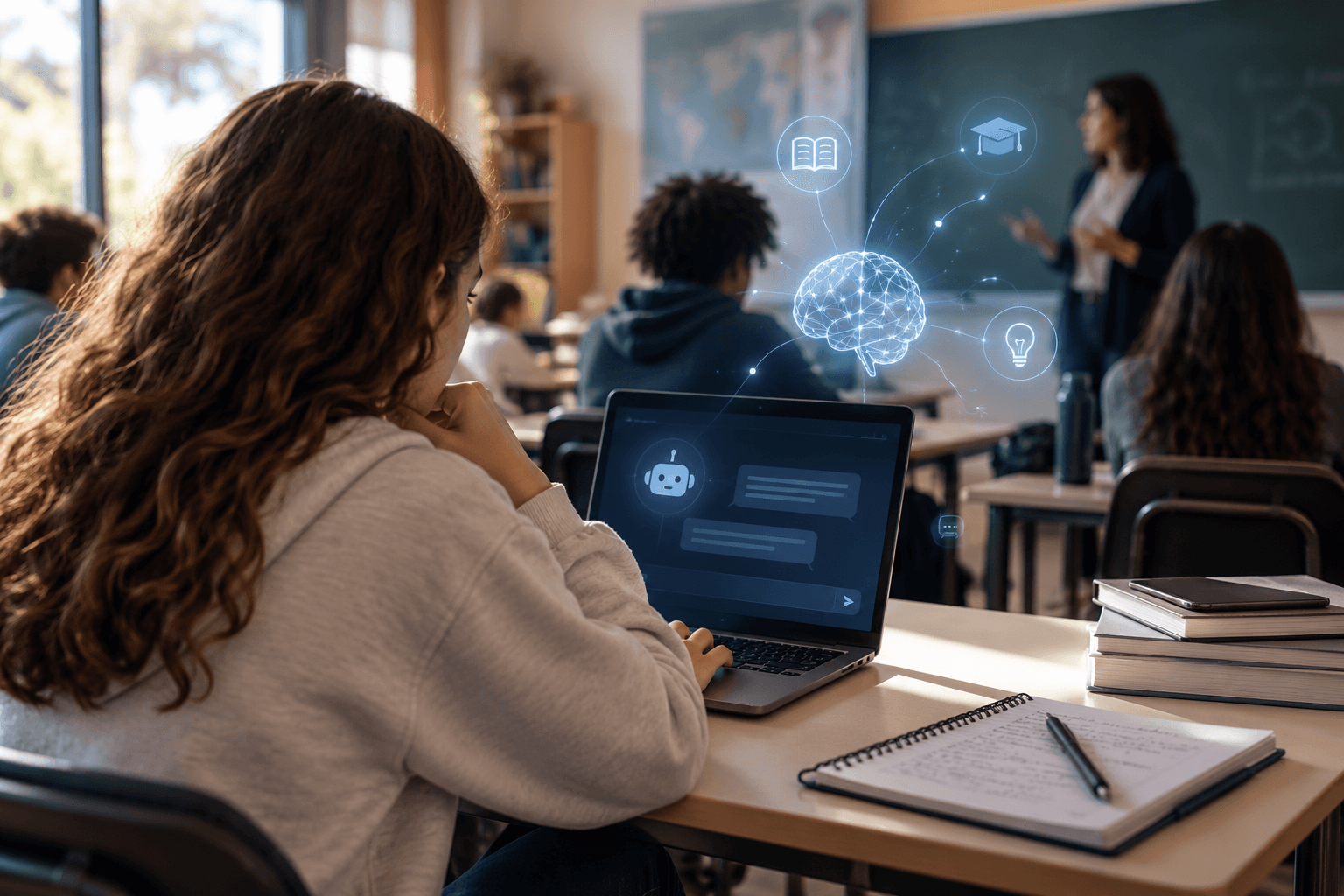
For a long time, using technology at school meant searching the internet, watching a video lesson or using an educational platform. Artificial intelligence has changed that relationship. Students can now ask for an explanation of something they did not understand, summarize a chapter, review a text, create questions to prepare for an exam or simply request a ready-made answer to an assignment. All of this can happen within seconds.
The discussion is no longer about when artificial intelligence will reach schools. It is already there and available both inside and outside the classroom. The challenge now is figuring out how to use it without turning a tool that can support learning into a shortcut that allows students to avoid learning altogether.
AI is already part of school life
Data from Brazil’s TIC Educação 2025 survey shows that 52% of Brazilian schools offering secondary education allow students to use artificial intelligence tools in educational activities. When all levels of education are considered, the figure is 37%. At the same time, only 22% of school administrators say their schools have guidelines on the use of artificial intelligence.
The technology has also become part of teachers’ routines. Previous TIC Educação data showed that 43% of primary and secondary school teachers had already used generative artificial intelligence to prepare educational content. Among secondary school teachers, the figure reached 58%. This shows that the discussion is not only about what students are doing with these tools. Teachers and schools are also learning how to incorporate them into everyday education.
Getting the answer doesn’t mean learning
This is one of the most important points in the discussion. A student can request an essay, the solution to a math problem or a summary of a book and receive a seemingly complete result within seconds. That convenience can be useful in many situations, but it can also create a false impression of learning.
The OECD Digital Education Outlook 2026 highlights this distinction. According to the OECD, recent studies suggest that generative artificial intelligence tools can improve students’ performance on certain tasks without necessarily producing equivalent gains in learning. In some studies reviewed by the organization, students produced better work while using AI, but part of that advantage disappeared when they had to complete assessments without the technology.
A better assignment, therefore, does not necessarily represent greater understanding. If artificial intelligence handles the entire process of interpretation, reasoning and writing the answer, a student may reach the expected result without fully understanding how they got there.
The problem isn’t simply using AI
The same technology that can provide a ready-made answer can also be used to learn. A student can ask AI to explain a concept in another way, provide examples, create questions to test their knowledge or identify problems in a text without completely rewriting it. They can also compare answers and check whether the information provided by the tool is accurate.
The difference lies largely in how the technology is used. This also makes the teacher’s role increasingly important, because the easier it becomes to generate an answer, the more important it is to teach students how to evaluate what they receive. Artificial intelligence systems can provide incorrect information, invent references and produce convincing answers even when they are wrong.
UNESCO takes a similar approach in its AI competency framework for students. The proposal goes beyond teaching students how to operate these tools. It also includes understanding their limitations, critically evaluating their outputs and developing a responsible relationship with the technology. Learning how to use AI also means learning how to question it.
Schools also need to learn how to deal with AI
The rapid development of these tools is forcing educational institutions to establish new rules. In September 2026, Brazil’s National Education Council approved guidelines for the use of artificial intelligence in education, addressing issues such as human oversight, student privacy, the use of personal data and automated decisions that may affect academic life.
The discussion goes far beyond whether a particular tool should be allowed during an assignment. Even if a school decides to completely restrict artificial intelligence in the classroom, students will still have access to it elsewhere. The technology is already present in smartphones, search engines, apps, text editors and many of the digital services people use every day.
In this context, teaching students how to deal with artificial intelligence may be more useful than simply trying to prevent its use. That includes explaining when the technology can be helpful, what information should not be shared, how to verify an answer and when students need to complete the work on their own.
The way students are assessed may also change
The presence of artificial intelligence raises another question for schools. If an assignment can be completed by a tool within seconds, it may be worth considering whether that assignment is still the best way to measure learning.
This does not mean abandoning exams, essays or school projects. Activities that also value the process may become increasingly important. Explaining how a conclusion was reached, comparing sources, identifying an error, defending an idea and justifying a choice are all ways of assessing something beyond the final answer.
Artificial intelligence itself can become part of this process. A teacher could present an AI-generated response and ask students to find errors, verify the information or propose a better answer. In this case, the technology is no longer simply a source of content. It also becomes something students need to analyze.
What now?
Artificial intelligence will probably continue to advance both inside and outside schools, and the tools available a few years from now will certainly be different from those used today. For that reason, the challenge for education may not be teaching students how to use one particular platform, but developing skills that remain important regardless of the technology.
Calculators did not eliminate the need to understand mathematics, and the internet did not eliminate the importance of knowing how to research. In the same way, having artificial intelligence capable of producing an answer does not eliminate the need to understand the subject. In a world where answers can be generated instantly, knowing how to ask questions, verify information, identify mistakes, build arguments and develop independent reasoning may become even more important.
Perhaps this is the main challenge artificial intelligence presents to education. Schools do not need to prepare students to compete with technology. They need to make sure students can still think, learn and make decisions when a ready-made answer is only seconds away.
Sources
Cetic.br / TIC Educação 2025. Survey on the use of digital technologies in Brazilian schools, published in 2026.
OECD. OECD Digital Education Outlook 2026: Exploring Effective Uses of Generative AI in Education. 2026.
UNESCO. AI Competency Framework for Students. Framework for the responsible and critical use of artificial intelligence.
Brazilian National Education Council (CNE). Guidelines for the use of artificial intelligence in education, approved in September 2026.